
II. Selection Criteria
The initial considerations for trimmer type selection are:
A. Resolution of adjustment
B. Setability and time to set
C. Physical and environmental conditions
D. Stability of setting required
E. Circuit packaging requirements
A. Resolution of Adjustment
1. Multiturns
• Multiturns provide better resolution than single turns. Models with a longer element exhibit better resolution than those with a short element. Typical multiturn shaft revolutions range from 15 to 20 turns for end to end travel.
• The contact design and stability are important considerations in achieving high resolution. The contact area must be small and the contact must move smoothly in order to provide high resolution. A noisy contact will make accurate setting very difficult.
• All trimmers utilize smooth cermet materials, precious metal wire brush contacts and backlash-free wiper designs that ensure high resolution setability.
• Reference multiturn models:
Square multiturns - 44, 64, 66, 67, 68
Rectangular multiturns 78, 89
2. Single Turns
• Single turn resolution for models with a longer cermet element (larger diameter) is quite respectable. This is especially true with wire brush contacts and smooth cermet films.
• Reference single turn models:
Small diameter - 24, 25, 62, 82
Larger diameter - 72, 91, 93
3. Surface
• Single turn - 21, 23, 83
• Multiturn - 44, 84
A trimmer can be used as potentiometer or rheostat. A potentiometer is a three terminal device typically used to vary voltage. In potentiometric configurations, the wiper terminal is lightly loaded so that wiper current is generally small.
A rheostat is a two terminal device typically used to control current. Wiper current is generally larger in rheostat circuits.
I. Types of Applications
The majority of applications for trimmers occur in electronic circuits.
Typical uses are in the following devices:
A. Amplifiers
B. Timing circuits
C. Voltage and current regulators
D. Voltage and frequency converters

Kt Kingtronics Tells You Trimming Potentiometers's General Mechanical Characteristics II
10 Mar 2016WELDABILITY:
The ability of materials to be welded together under specified conditions.
TERMINAL STRENGTH:
The ability of the terminals to withstand specified mechanical stresses without sustaining damage that would affect utility of the terminals or operation of the trimming potentiometer.
IMMERSION SEALED:
The ability of the unit to withstand submersion in acceptable cleaning solutions used in normal soldering processes without performance degradation under specific environmental conditions.
TORQUE
STARTING (OPERATING) TORQUE:
The maximum moment in the clockwise and counterclockwise directions required to initiate shaft adjustment anywhere in the mechanical travel.
STOP TORQUE:
The maximum static moment that can be applied to adjustment shaft at each mechanical stop for a specified period of time without loss of continuity or mechanical damage affecting operational characteristics.
SOLDERABILITY:
The ability of the terminals to accept a uniform coating of solder under specified conditions.
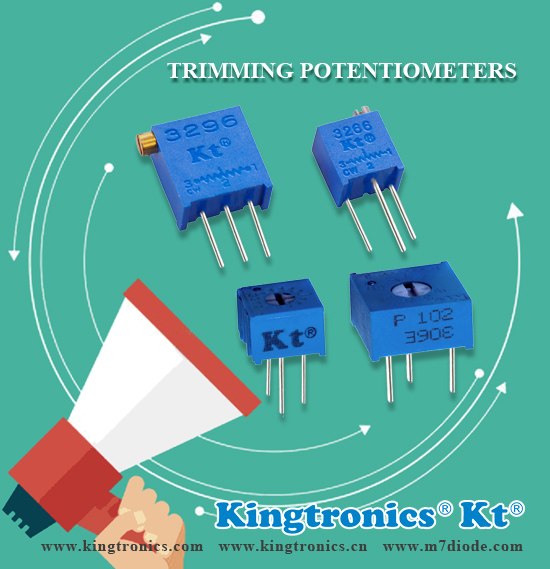
Kingtronics offers full range of Trimming Potentiometers with our own trademark "Kt" since 1990.
We gain high reputation by our trimpots superior quality and competitive price. We are proud that Kingtronics Trimpot are well-known in the overseas market.
In Jan 2016, we prepared all the key raw materials of Trimming Potentiometers and then handed over to SGS laboratory.
After 1 week testing , we got the positive reply of our potentiometers from SGS company. Now we would like to share this good news with our Kingtronics faithful customer.
Kingtronics Trimming Potentiometer is your first chosie, and Kingtronics is your best partner.
More details about our RoHS 2.0 Report, please visit below link:
http://www.kingtronics.com/pdf/Trimming-potentiometer-RoHS.pdf

ROTATIONAL LIFE:
The number of cycles obtainable under specific operating conditions while remaining within specified allowable degradation. A cycle is defined as one complete traversal of the wiper over the resistive element in both directions.
LOAD LIFE:
The number of hours at which a device may dissipate rated power under specified operating conditions while remaining within specified allowable degradations.
ADJUSTABILITY:
Defines the precision with which the output of a device can be set to the desired value.
ADJUSTABILITY (OUTPUT RESISTANCE):
The precision with which the output resistance of a device can be set to the desired value.
ADJUSTABILITY (OUTPUT VOLTAGE RATIO):
The precision with which the output voltage ratio of a device can be set to the desired value.
Kt Kingtronics Tells You Trimming Potentiometers's General Electrical Characteristics IV
21 Jan 2016CONTINUITY:
Continuity is the maintenance of continuous electrical contact between the wiper and both end terminals of the resistive element.
SETTING STABILITY:
The amount of change in the output voltage, without readjustment, expressed as a percentage of the total applied voltage.
DIELECTRIC STRENGTH:
The ability to withstand the application of a specified potential of a given characteristic, between the terminals and all other external conducting member such as shaft, housing and mounting hardware without exceeding a specified leakage current value.
INSULATION RESISTANCE:
The resistance to a specified dc voltage impressed between the terminals and all other external conducting members such as shaft, housing and mounting hardware.
POWER RATING:
The maximum power that a trimming potentiometer can dissipate across the total resistive element under specified conditions while meeting specified performance requirements.
CONTACT RESISTANCE VARIATION: (CRV)
The apparent resistance seen between the wiper and the resistance element when the wiper is energized with a specified current and moved over the adjustment travel in either direction at a constant speed. The output variations are measured over a specified frequency bandwidth, exclusive of the effects due to roll-on or roll-off of the terminations and is expressed in ohms or % of Rt.
EQUIVALENT NOISE RESISTANCE: (ENR)
(Wirewound only) Any spurious variation in the electrical output not present in the input, defined quantitatively in terms of an equivalent parasitic, transient resistance in ohms, appearing between the contact and the resistive element when the shaft is rotated or translated. The Equivalent Noise Resistance is defined independently of the resolution, functional characteristics and the total travel. The magnitude of the Equivalent Noise Resistance is the maximum departure from a specific reference line. The wiper of the potentiometer is required to be excited by a specific current and moved at a specific speed.
RESISTANCE-TEMPERATURE CHARACTERISTIC: (RTC)
The difference between the total resistance values measured at a reference temperature of 25°C and the specified test temperature expressed as a percent of the Total Resistance.
Where:
R1 = Resistance at reference temperature (25°C) in ohms
R2 = Resistance at the test temperature in ohms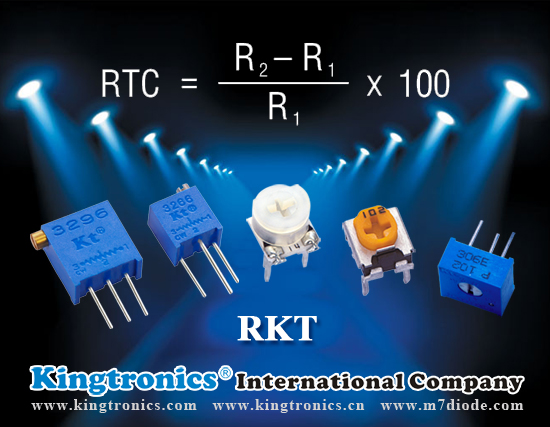
TOTAL RESISTANCE: (Rt)
The dc resistance between the input terminals with the wiper positioned to either end stop, or in dead band for continuous rotation potentiometers.
ABSOLUTE MINIMUM RESISTANCE: (Rm)
The resistance measured between the wiper terminal and each end terminal with the wiper positioned to give a minimum value.
END RESISTANCE: (Re)
The resistance measured between the wiper terminal and an end terminal when the wiper is positioned at the corresponding end of mechanical travel.
Absolute minimum resistance and end resistance are synonymous for continuous rotation trimmers.
TEMPERATURE COEFFICIENT OF RESISTANCE: (TC)
The unit change in resistance per degree celsius change from a reference temperature, expressed in parts per million per degree celsius as follows: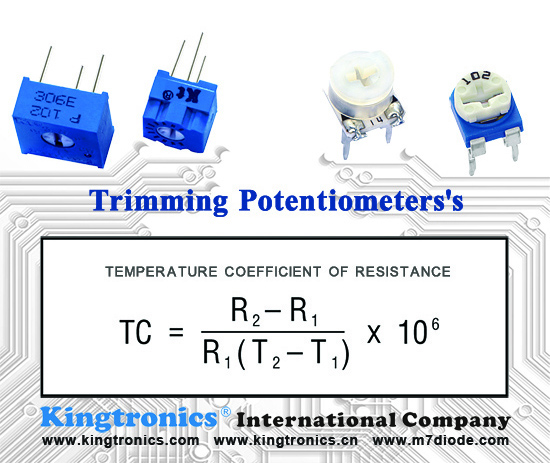
Where:
R1 = Resistance at reference temperature in ohms
R2 = Resistance at test temperature in ohms
T1 = Reference temperature in degrees celsius
T2 = Test temperature in degrees Celsius
Contact us
Tel: (86) 769 8118 8110
Tel: (852) 8106 7033
Fax: (852) 8106 7099
E-mail: info@kingtronics.com
Microsoft Teams: Kingtronics.sales via Teams
WhatsApp: Chat with us on WhatsApp
Web: www.Kingtronics.com
YouTube: www.youtube.com/c/Kingtronicskt
About
Kingtronics International Company was established in 1995 located in Dongguan City of China to handle all sales & marketing for factories located in Chengdu, Sichuan and Zhaoqing, Guangdong, China. In 1990, we established the first factory to produce trimming potentiometer and in 1999 we built up new factory in Zhao Qing, Guangdong. Now with around 850 workers, Kingtronics produce trimming potentiometers, dipped tantalum capacitors, multilayer ceramic capacitors, and diode & bridge rectifier. We sell good quality under our brand Kingtronics, and Kt, King, Kingtronics are our three trademarks. All our products are RoHS compliant, and our bridge rectifier have UL approval. Please visit our Products page, you could please download all our PDF datasheet and find cross reference for our Trimming Potentiometer and capacitors.
Tantalum and Ceramic Capacitors Cross Reference ↓ Download
Diodes & Rectifiers List(PDF: 97KB) ↓ Download
Trimming Potentiometer Cross Reference ↓Download
Categories
 Kt Kingtronics (252)
- Aluminum Electrolytic Capacitor (165)
- Diodes & Rectifiers (162)
- Trimming Potentiometers (130)
- Tantalum Capacitors (96)
- Multilayer Ceramic Capacitors (70)
- Kt Bridge Rectifier (66)
- Quartz Crystals (65)
- Film Capacitors (44)
- Surge Arresters (34)
- Tactile Switches (34)
- Kt Kingtronics Components (31)
- Ceramic Trimmer Capacitors (27)
- Super Capacitors (22)
- Metal Oxide Varistor (13)
- Negative Temperature Coefficient Thermistor (6)
- Special Purpose Film Capacitors (3)
- Music capacitors (2)
- Conduction Cooled Capacitors (1)
- Audio Capacitors (1)
- Resistors (2)
- LED Display Modules (1)
Archives
- 2026 June (1)
- 2026 May (2)
- 2026 April (1)
- 2026 March (1)
- 2026 February (2)
- 2026 January (2)
- 2025 December (3)
- 2025 November (2)
- 2025 October (2)
- 2025 September (4)
- 2025 August (4)
- 2025 July (4)
- 2025 June (6)
- 2025 May (4)
- 2025 April (3)
- 2025 March (3)
- 2025 February (3)
- 2025 January (4)
- 2024 December (2)
- 2024 November (5)
- 2024 October (4)
- 2024 September (6)
- 2024 August (9)
- 2024 July (6)
- 2024 June (5)
- 2024 May (3)
- 2024 April (3)
- 2024 March (2)
- 2024 February (2)
- 2024 January (3)
- 2023 December (1)
- 2023 November (2)
- 2023 October (1)
- 2023 September (2)
- 2023 August (2)
- 2023 July (4)
- 2023 June (12)
- 2023 May (6)
- 2023 April (4)
- 2023 March (3)
- 2023 February (2)
- 2023 January (1)
- 2022 December (3)
- 2022 November (2)
- 2022 October (3)
- 2022 September (4)
- 2022 August (3)
- 2022 July (3)
- 2022 June (2)
- 2022 May (3)
- 2022 April (4)
- 2022 March (4)
- 2022 February (2)
- 2022 January (3)
- 2021 December (4)
- 2021 November (3)
- 2021 October (4)
- 2021 September (4)
- 2021 August (4)
- 2021 July (4)
- 2021 June (5)
- 2021 May (4)
- 2021 April (3)
- 2021 March (4)
- 2021 February (4)
- 2021 January (4)
- 2020 December (5)
- 2020 November (4)
- 2020 October (4)
- 2020 September (7)
- 2020 August (8)
- 2020 July (9)
- 2020 June (8)
- 2020 May (9)
- 2020 April (11)
- 2020 March (6)
- 2020 February (4)
- 2020 January (4)
- 2019 December (6)
- 2019 November (7)
- 2019 October (6)
- 2019 September (5)
- 2019 August (9)
- 2019 July (6)
- 2019 June (4)
- 2019 May (16)
- 2019 April (6)
- 2019 March (6)
- 2019 February (9)
- 2019 January (5)
- 2018 December (4)
- 2018 November (4)
- 2018 October (5)
- 2018 September (8)
- 2018 August (10)
- 2018 July (7)
- 2018 June (12)
- 2018 May (22)
- 2018 April (4)
- 2018 March (4)
- 2018 February (8)
- 2018 January (13)
- 2017 December (4)
- 2017 November (4)
- 2017 October (5)
- 2017 September (4)
- 2017 August (20)
- 2017 July (7)
- 2017 June (5)
- 2017 May (4)
- 2017 April (4)
- 2017 March (8)
- 2017 February (8)
- 2017 January (8)
- 2016 December (10)
- 2016 November (16)
- 2016 October (8)
- 2016 September (10)
- 2016 August (13)
- 2016 July (12)
- 2016 June (10)
- 2016 May (14)
- 2016 April (8)
- 2016 March (10)
- 2016 February (6)
- 2016 January (8)
- 2015 December (10)
- 2015 November (8)
- 2015 October (3)
- 2015 July (5)
- 2015 June (9)
- 2015 May (7)
- 2015 April (8)
- 2015 March (9)
- 2015 February (7)
- 2015 January (5)
- 2014 December (13)
- 2014 November (4)
- 2014 October (4)
- 2014 September (5)
- 2014 August (4)
- 2014 July (4)
- 2014 June (4)
- 2014 May (4)
- 2014 April (4)
- 2014 March (5)
- 2014 February (3)
- 2014 January (4)
- 2013 December (8)
- 2013 November (9)
- 2013 October (10)
- 2013 September (9)
- 2013 August (11)
- 2013 July (10)
- 2013 June (3)
- 2013 May (4)
- 2013 April (3)
- 2013 March (2)
- 2013 February (1)
- 2013 January (3)
- 2012 December (5)
- 2012 November (6)
- 2012 October (5)
- 2012 September (10)
- 2012 August (11)
- 2012 July (11)
- 2012 June (12)
- 2012 May (14)
- 2012 April (9)
- 2012 March (14)
- 2012 February (9)
- 2012 January (6)
- 2011 December (9)
- 2011 November (11)
- 2011 October (10)
- 2011 September (13)
- 2011 August (14)
- 2011 July (13)
- 2011 June (13)
- 2011 May (13)
- 2011 April (14)
- 2011 March (27)
- 2011 February (13)
- 2011 January (24)
- 2010 December (21)
- 2010 November (12)
- 2010 October (11)