
A Zener Diode is a special kind of diode which permits current to flow in the forward direction as normal, but will also allow it to flow in the reverse direction when the voltage is above a certain value - the breakdown voltage known as the Zener voltage.
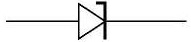
The Zener voltage of a standard diode is high, but if a reverse current above that value is allowed to pass through it, the diode is permanently damaged. Zener diodes are designed so that their Zener voltage is much lower - for example just 2.4 Volts. When a reverse current above the Zener voltage passes through a Zener diode, there is a controlled breakdown which does not damage the diode. The voltage drop across the Zener diode is equal to the Zener voltage of that diode no matter how high the reverse bias voltage is above the Zener voltage.
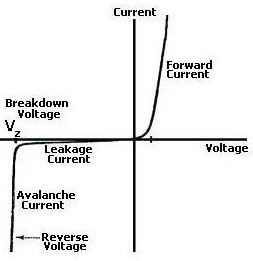
The illustration above shows this phenomenon in a Current vs. Voltage graph. With a Zener diode connected in the forward direction, it behaves exactly the same as a standard diode - i.e. a small voltage drop of 0.3 to 0.7V with current flowing through pretty much unrestricted. In the reverse direction however there is a very small leakage current between 0V and the Zener voltage - i.e. just a tiny amount of current is able to flow. Then, when the voltage reaches the breakdown voltage (Vz), suddenly current can flow freely through it.
Uses of Zener Diodes
Since the voltage dropped across a Zener Diode is a known and fixed value, Zener diodes are typically used to regulate the voltage in electric circuits. Using a resistor to ensure that the current passing through the Zener diode is at least 5mA (0.005 Amps), the circuit designer knows that the voltage drop across the diode is exactly equal to the Zener voltage of the diode.
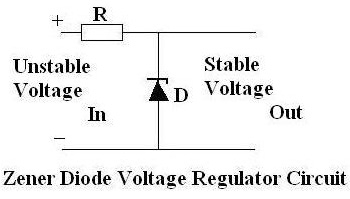
A Zener diode can be used to make a simple voltage regulation circuit as pictured above. The output voltage is fixed at the Zener voltage of the Zener diode used and so can be used to power devices requiring a fixed voltage.
If you have any inquiry about Zener diode, pls contact info@kingtronics.com
- 0Commentary
- Tags:
Kt Kingtronics Diode Switching Circuits
6 Jan 2011Diodes can switch analog signals. A reverse biased diode appears to be an open circuit. A forward biased diode is a low resistance conductor. The only problem is isolating the AC signal being switched from the DC control signal. The circuit in Figure below is a parallel resonant network: resonant tuning inductor paralleled by one (or more) of the switched resonator capacitors. This parallel LC resonant circuit could be a preselector filter for a radio receiver. It could be the frequency determining network of an oscillator (not shown). The digital control lines may be driven by a microprocessor interface.

Kingtronics www.kingtronics.com provide Fast Switching Diode LL4148 Minimelf SOD80 .The features of Fast Switching Diode LL4148 Minimelf SOD80 are below:
- LL4148 small signal diode
- Fast switching surface mount diode
- Low reverse leakage
- Fast switching speed
- Maximum power dissipation 500mW
- High stability and high reliability
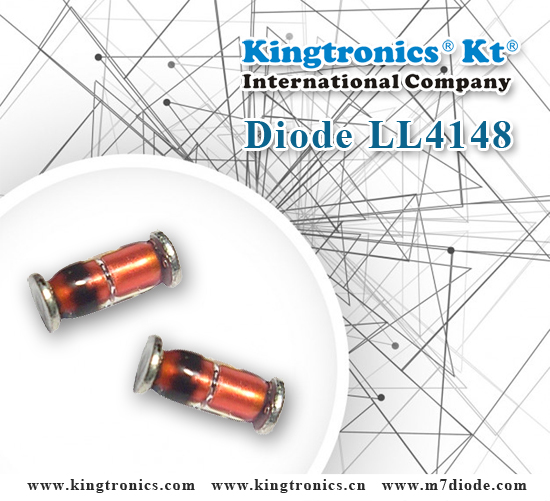
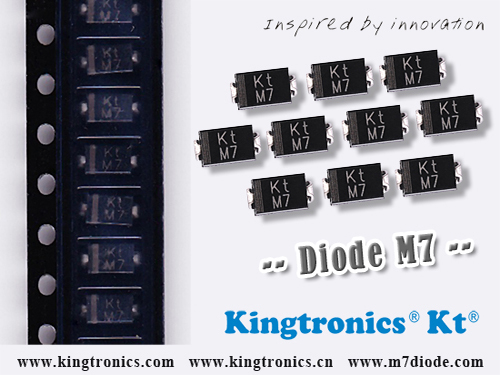
Kt Kingtronics Diode M7 (S1M GS1M) SMA, LL4148 MINIMELF, SM4007 Melf, BZV55C MINIMELF, 1N4007 DO-41 RoHS
21 Dec 2010Diode rectifier M7: Lead time: 3-4 weeks
Price is much better than Diotec, Panjit, Vishay, Onsemi...
Welcome to send inquiry to us!
Diode Package: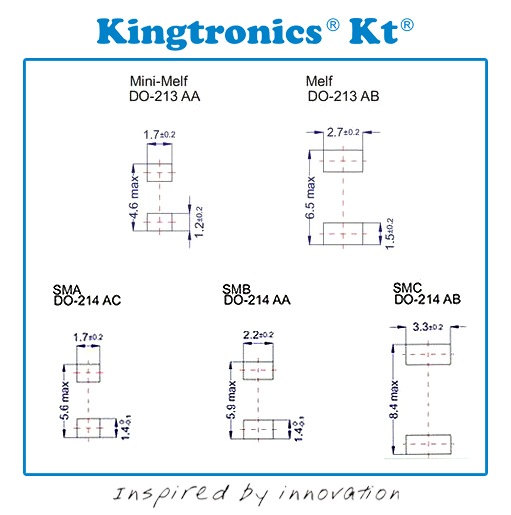
About Zener Diodes
16 Dec 2010Functionally, Zener diodes are used as regulators, limiters and to control output switching. When used as regulators, the constant reverse voltage of Zener diodes allows for the regulation of output voltage against both variations in the input voltage from an unregulated power supply and from variations in the load resistance. The current traveling through Zener diodes changes to keep the voltage within the threshold of Zener action and the maximum power it can dissipate. Zener regulators tend to most efficiently function when constant voltage is applied, especially when used in conjunction with regulated power supplies, and for limiter applications.
Zener limiters are constructed with two opposing Zener diodes. Each individual diode can limit one side of a sinusoidal waveform to Zener voltage while keeping the other side near zero. When the two opposing Zener diodes are paired, the waveform is limited to Zener voltage on both polarities.
Zener diodes are also used to control output switching. In this application, Zener diodes switch the output between voltages. This is determined by the changes in input voltage through the diode. The output circuit amounts to a Zener regulator that switches from one Zener voltage to the other on transition through the Zener diode.
Kingtronics supply all kinds of Zener Diodes BZV55C & ZMM55C, http://www.kingtronics.com/pdf/BZV55C.pdf has detailed introduce Zener Diode’s features and types.
- 0Commentary
- Tags:
Types of Diode
9 Dec 2010There are many different types of diodes that are available for use in electronics design. Different semiconductor diode types can be used to perform different functions as a result of the properties of these different diode types.
Semiconductor diodes can be used for many applications. The basic application is obviously to rectify waveforms. This can be used within power supplies or within radio detectors. Signal diodes can also be used for many other functions within circuits where the "one way" effect of a diode may be required.
Kingtronics sell many different types of diode, in our website we have a full products list of diode & rectifiers, please go to Products link and have a view.
- 0Commentary
- Tags:
The way of testing Diode
4 Dec 2010Kingtronics produce and sell many different kinds of diodes, and at Kingtronics’ s blog we will tell you how to test a Diode:
You can use a multimeter or a simple tester (battery, resistor and LED) to check that a diode conducts in one direction but not the other. A lamp may be used to test a rectifier diode, but do NOT use a lamp to test a signal diode because the large current passed by the lamp will destroy the diode!
Using these way you can confirm if your Diode is working or not. Kingtronics diode include: M7, 1N4001S-1N4007S, 1N4001-1N4007, 1N5391-1N5399, RL201-RL207, 1N5400-1N5408, 6A05-6A10, FR101-FR107, 1N4933-1N4937, FR151-FR157, FR201-FR207, 1N5817-1N5819, 1N5820-1N5822, LL4148, BZV55C & ZMM55C, RS1M, SM4007 melf, UF4007.If you are interested in these diode, welcome to visit www.kingtronics.com.
- 0Commentary
- Tags:
Kt Kingtronics Rectifier's Application
29 Nov 2010Rectifiers find a use in detection of amplitude modulated radio signals. The signal may be amplified before detection, but if un-amplified, a very low voltage drop diode must be used. When using a rectifier for demodulation the capacitor and load resistance must be carefully matched. Too low a capacitance will result in the high frequency carrier passing to the output and too high will result in the capacitor just charging and staying charged.
Kingtronics’s fast recovery rectifier diodes are very popular in the overseas market, According to the rectifier’ s application , Our Kingtronics managing ordinary rectifier diodes, ultra-fast rectifier diodes. In our Kingtronics website www.kingtronics.com ,we have detailed PDF about all kinds of diodes & rectifiers.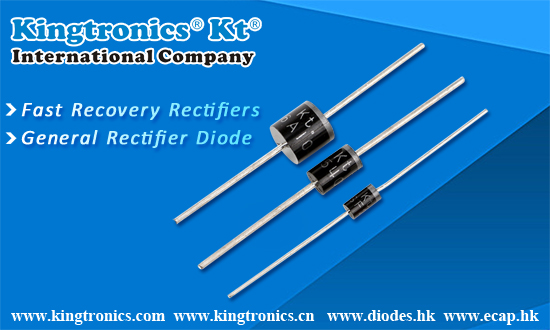
- 0Commentary
- Tags:Kt Kingronics Kt fast response rectifier diodes Kt High ripple current Aluminum Elec capacitors Bridge rectifiers appreciating chrysanthemum business cooperation Chip multilayer ceramic capacitors Communications Equipment Equipment Manufacturers Passive Electronics Components The supply voltage trimmer potentiometers Zener Diodes
Kt Kingtronics Zener Diodes
26 Nov 2010Zener diodes are used to maintain a fixed voltage. They are designed to 'breakdown' in a reliable and non-destructive way so that they can be used in reverse to maintain a fixed voltage across their terminals.
Zener diodes can be distinguished from ordinary diodes by their code and breakdown voltage which are printed on them. Zener diode codes begin BZX... or BZY... Their breakdown voltage is printed with V in place of a decimal point, so 4V7 means 4.7V for example.
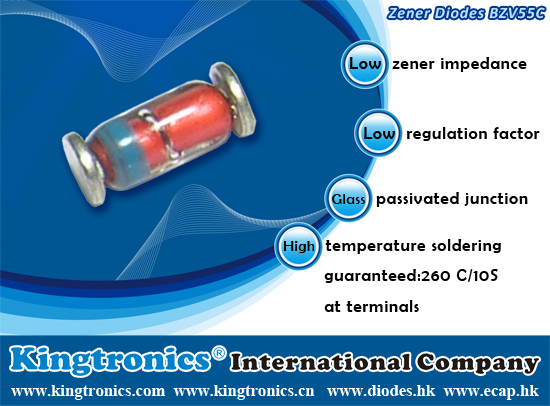
Kingtronics supplies BZV55C/ZMM55C-SERIES with Low zener impedance,Low regulation factor,Glass passivated junction,High temperature soldering guaranteed:260 C/10S at terminals. Please link http://www.kingtronics.com/pdf/BZV55C.pdf ,you will see all series of our Zener diodes.
Kt Kingtronics Introduce Function of Diode
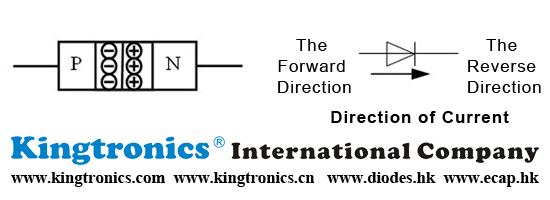
23 Nov 2010The most common function of a diode is to allow electric current to pass in one direction (known as the forward direction) while blocking current in the opposite direction (reverse direction). This behavior, called rectification, is crucial for converting alternating current (AC) to direct current (DC) and extracting modulation from radio signals in radio receivers. Essentially, the diode acts as an electronic version of a check valve.
Different types of diodes serve different functions, depending on factors such as voltage, temperature, and other specifications. It is important to understand these characteristics when selecting a diode for your application.
At Kingtronics, we provide detailed information about the functions and specifications of our diodes. If you have any questions or need assistance, please visit our website at www.kingtronics.com for helpful suggestions and product details.
Kt Kingtronics Diodes
22 Nov 2010In electronics, a diode is a two-terminal component that allows electric current to flow in only one direction. The most common type today is the semiconductor diode, which consists of a crystalline piece of semiconductor material connected to two electrical terminals. A vacuum tube diode, though less common now, consists of a plate and cathode and is still used in some high-power technologies.
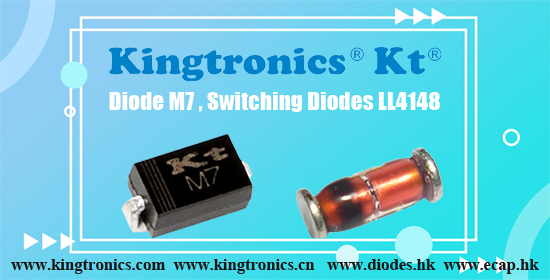
Kingtronics produces and sells a wide variety of diodes, including general-purpose diodes like M7 and switching diodes like LL4148. These diodes are widely used in applications such as LCDs, TVs, and many other electronic fields.
To explore our full product list, visit: Kingtronics Products and discover the range of diodes we offer.
Contact us
Tel: (86) 769 8118 8110
Tel: (852) 8106 7033
Fax: (852) 8106 7099
E-mail: info@kingtronics.com
Microsoft Teams: Kingtronics.sales via Teams
WhatsApp: Chat with us on WhatsApp
Web: www.Kingtronics.com
YouTube: www.youtube.com/c/Kingtronicskt
About
Kingtronics International Company was established in 1995 located in Dongguan City of China to handle all sales & marketing for factories located in Chengdu, Sichuan and Zhaoqing, Guangdong, China. In 1990, we established the first factory to produce trimming potentiometer and in 1999 we built up new factory in Zhao Qing, Guangdong. Now with around 850 workers, Kingtronics produce trimming potentiometers, dipped tantalum capacitors, multilayer ceramic capacitors, and diode & bridge rectifier. We sell good quality under our brand Kingtronics, and Kt, King, Kingtronics are our three trademarks. All our products are RoHS compliant, and our bridge rectifier have UL approval. Please visit our Products page, you could please download all our PDF datasheet and find cross reference for our Trimming Potentiometer and capacitors.
Tantalum and Ceramic Capacitors Cross Reference ↓ Download
Diodes & Rectifiers List(PDF: 97KB) ↓ Download
Trimming Potentiometer Cross Reference ↓Download
Categories
 Kt Kingtronics (252)
- Aluminum Electrolytic Capacitor (165)
- Diodes & Rectifiers (162)
- Trimming Potentiometers (130)
- Tantalum Capacitors (96)
- Multilayer Ceramic Capacitors (70)
- Kt Bridge Rectifier (66)
- Quartz Crystals (65)
- Film Capacitors (44)
- Surge Arresters (34)
- Tactile Switches (34)
- Kt Kingtronics Components (31)
- Ceramic Trimmer Capacitors (27)
- Super Capacitors (22)
- Metal Oxide Varistor (13)
- Negative Temperature Coefficient Thermistor (6)
- Special Purpose Film Capacitors (3)
- Music capacitors (2)
- Conduction Cooled Capacitors (1)
- Audio Capacitors (1)
- Resistors (2)
- LED Display Modules (1)
Archives
- 2026 June (1)
- 2026 May (2)
- 2026 April (1)
- 2026 March (1)
- 2026 February (2)
- 2026 January (2)
- 2025 December (3)
- 2025 November (2)
- 2025 October (2)
- 2025 September (4)
- 2025 August (4)
- 2025 July (4)
- 2025 June (6)
- 2025 May (4)
- 2025 April (3)
- 2025 March (3)
- 2025 February (3)
- 2025 January (4)
- 2024 December (2)
- 2024 November (5)
- 2024 October (4)
- 2024 September (6)
- 2024 August (9)
- 2024 July (6)
- 2024 June (5)
- 2024 May (3)
- 2024 April (3)
- 2024 March (2)
- 2024 February (2)
- 2024 January (3)
- 2023 December (1)
- 2023 November (2)
- 2023 October (1)
- 2023 September (2)
- 2023 August (2)
- 2023 July (4)
- 2023 June (12)
- 2023 May (6)
- 2023 April (4)
- 2023 March (3)
- 2023 February (2)
- 2023 January (1)
- 2022 December (3)
- 2022 November (2)
- 2022 October (3)
- 2022 September (4)
- 2022 August (3)
- 2022 July (3)
- 2022 June (2)
- 2022 May (3)
- 2022 April (4)
- 2022 March (4)
- 2022 February (2)
- 2022 January (3)
- 2021 December (4)
- 2021 November (3)
- 2021 October (4)
- 2021 September (4)
- 2021 August (4)
- 2021 July (4)
- 2021 June (5)
- 2021 May (4)
- 2021 April (3)
- 2021 March (4)
- 2021 February (4)
- 2021 January (4)
- 2020 December (5)
- 2020 November (4)
- 2020 October (4)
- 2020 September (7)
- 2020 August (8)
- 2020 July (9)
- 2020 June (8)
- 2020 May (9)
- 2020 April (11)
- 2020 March (6)
- 2020 February (4)
- 2020 January (4)
- 2019 December (6)
- 2019 November (7)
- 2019 October (6)
- 2019 September (5)
- 2019 August (9)
- 2019 July (6)
- 2019 June (4)
- 2019 May (16)
- 2019 April (6)
- 2019 March (6)
- 2019 February (9)
- 2019 January (5)
- 2018 December (4)
- 2018 November (4)
- 2018 October (5)
- 2018 September (8)
- 2018 August (10)
- 2018 July (7)
- 2018 June (12)
- 2018 May (22)
- 2018 April (4)
- 2018 March (4)
- 2018 February (8)
- 2018 January (13)
- 2017 December (4)
- 2017 November (4)
- 2017 October (5)
- 2017 September (4)
- 2017 August (20)
- 2017 July (7)
- 2017 June (5)
- 2017 May (4)
- 2017 April (4)
- 2017 March (8)
- 2017 February (8)
- 2017 January (8)
- 2016 December (10)
- 2016 November (16)
- 2016 October (8)
- 2016 September (10)
- 2016 August (13)
- 2016 July (12)
- 2016 June (10)
- 2016 May (14)
- 2016 April (8)
- 2016 March (10)
- 2016 February (6)
- 2016 January (8)
- 2015 December (10)
- 2015 November (8)
- 2015 October (3)
- 2015 July (5)
- 2015 June (9)
- 2015 May (7)
- 2015 April (8)
- 2015 March (9)
- 2015 February (7)
- 2015 January (5)
- 2014 December (13)
- 2014 November (4)
- 2014 October (4)
- 2014 September (5)
- 2014 August (4)
- 2014 July (4)
- 2014 June (4)
- 2014 May (4)
- 2014 April (4)
- 2014 March (5)
- 2014 February (3)
- 2014 January (4)
- 2013 December (8)
- 2013 November (9)
- 2013 October (10)
- 2013 September (9)
- 2013 August (11)
- 2013 July (10)
- 2013 June (3)
- 2013 May (4)
- 2013 April (3)
- 2013 March (2)
- 2013 February (1)
- 2013 January (3)
- 2012 December (5)
- 2012 November (6)
- 2012 October (5)
- 2012 September (10)
- 2012 August (11)
- 2012 July (11)
- 2012 June (12)
- 2012 May (14)
- 2012 April (9)
- 2012 March (14)
- 2012 February (9)
- 2012 January (6)
- 2011 December (9)
- 2011 November (11)
- 2011 October (10)
- 2011 September (13)
- 2011 August (14)
- 2011 July (13)
- 2011 June (13)
- 2011 May (13)
- 2011 April (14)
- 2011 March (27)
- 2011 February (13)
- 2011 January (24)
- 2010 December (21)
- 2010 November (12)
- 2010 October (11)